
If your buyers ask Google, ChatGPT, Perplexity, Claude, or Copilot for recommendations, your website is no longer competing only for a blue link. It is competing to become part of the answer.
That shift is called Generative Engine Optimization, or GEO. Traditional SEO still matters, but GEO adds a new layer: entity clarity, citation-worthiness, machine-readable structure, topical authority, and third-party proof.
What Makes GEO Different From SEO?
SEO helps a page rank. GEO helps a source get used.
That difference matters because answer engines often respond without sending the user to a traditional list of search results. A buyer might ask, "Who should I hire for privacy-first web design?" and receive a synthesized recommendation with a few cited sources. If your brand is absent from that answer, you may never enter the buyer's consideration set.
| Area | Traditional SEO | GEO / AI Search |
|---|---|---|
| Primary goal | Rank higher and earn organic clicks. | Be mentioned, summarized, or cited inside generated answers. |
| Winning unit | A page that ranks for a query. | A self-contained fact, paragraph, framework, comparison, or source. |
| Content need | Coverage, search intent, internal links, authority. | Extractability, entity clarity, source quality, and direct answers. |
| Proof signal | Links, engagement, rankings, local signals. | Links plus reviews, brand mentions, structured profiles, and corroboration. |
| Measurement | Rankings, impressions, clicks, conversions. | Mentions, citations, answer accuracy, share of voice, competitor presence. |
The important part: GEO does not replace SEO. It makes weak SEO more obvious. If your site is slow, vague, thin, or untrusted, AI answer engines have little reason to include it.
How AI Answer Engines Choose Sources
Most AI search systems use some version of retrieval-augmented generation, often called RAG. The system receives a query, retrieves relevant documents, scores them, synthesizes an answer, and may cite the sources that contributed to the response.
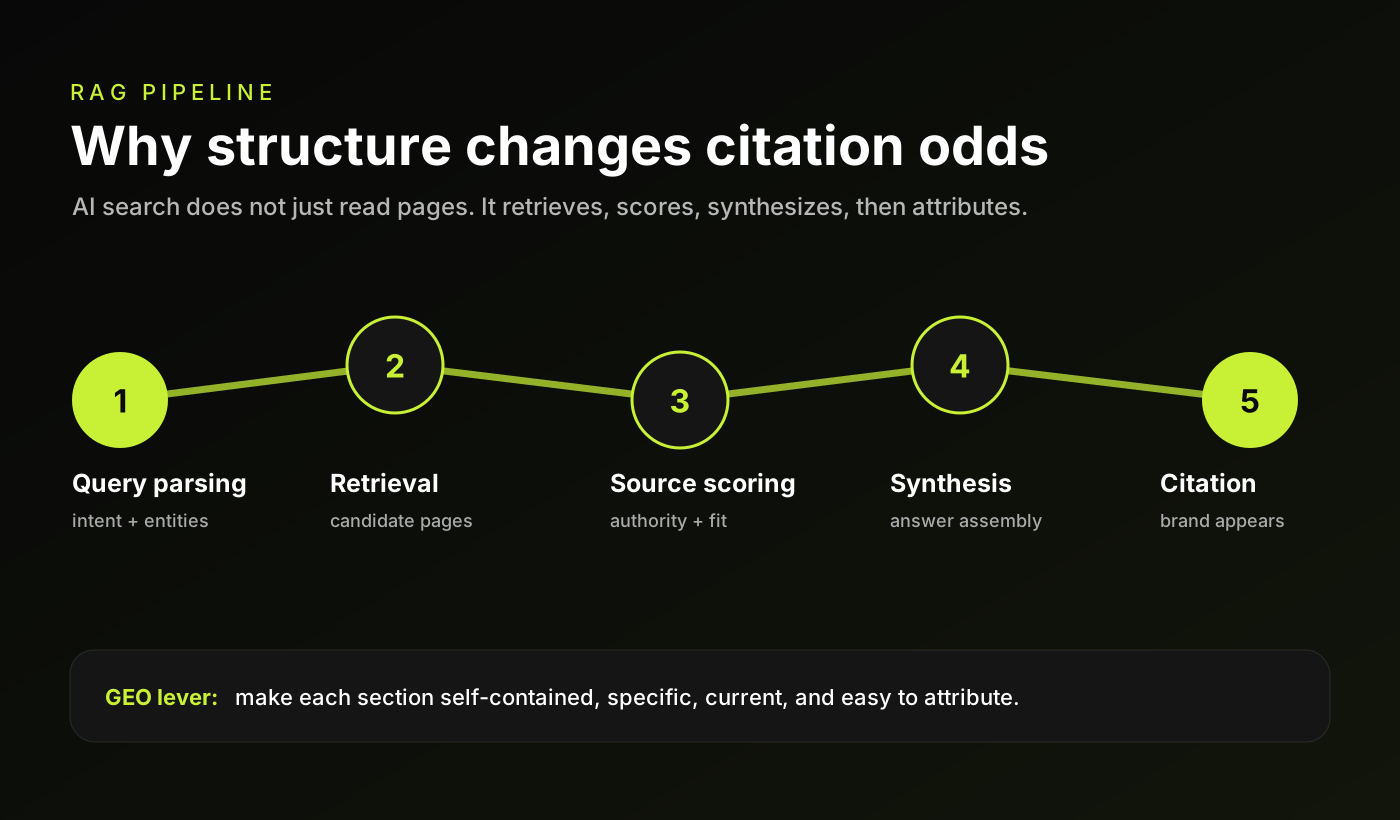
Your content has to succeed at multiple stages:
- It must be discoverable and crawlable.
- It must be semantically relevant to the query.
- It must be trusted enough to use.
- It must be structured clearly enough to extract.
- It must be specific enough to cite.
This is why generic content fails. An AI system does not need another paragraph saying "SEO is important." It needs a clear, current, attributable answer that helps solve the user's question.
The CITE Framework for GEO
Use CITE as the operating model:
Make the business, services, audience, location, proof, and ownership unmistakable.
Write sections that can stand alone as quotable answers, definitions, comparisons, and checklists.
Align reviews, profiles, links, citations, case studies, and third-party mentions with the same story.
Track whether answer engines mention you, cite you, describe you accurately, and prefer competitors.
This framework is intentionally simple. The goal is not to chase every new AI-search rumor. The goal is to make your business easier to understand, verify, quote, and recommend.
The GEO Audit Scorecard
Use this scorecard to turn GEO from a vague concept into an actionable backlog.
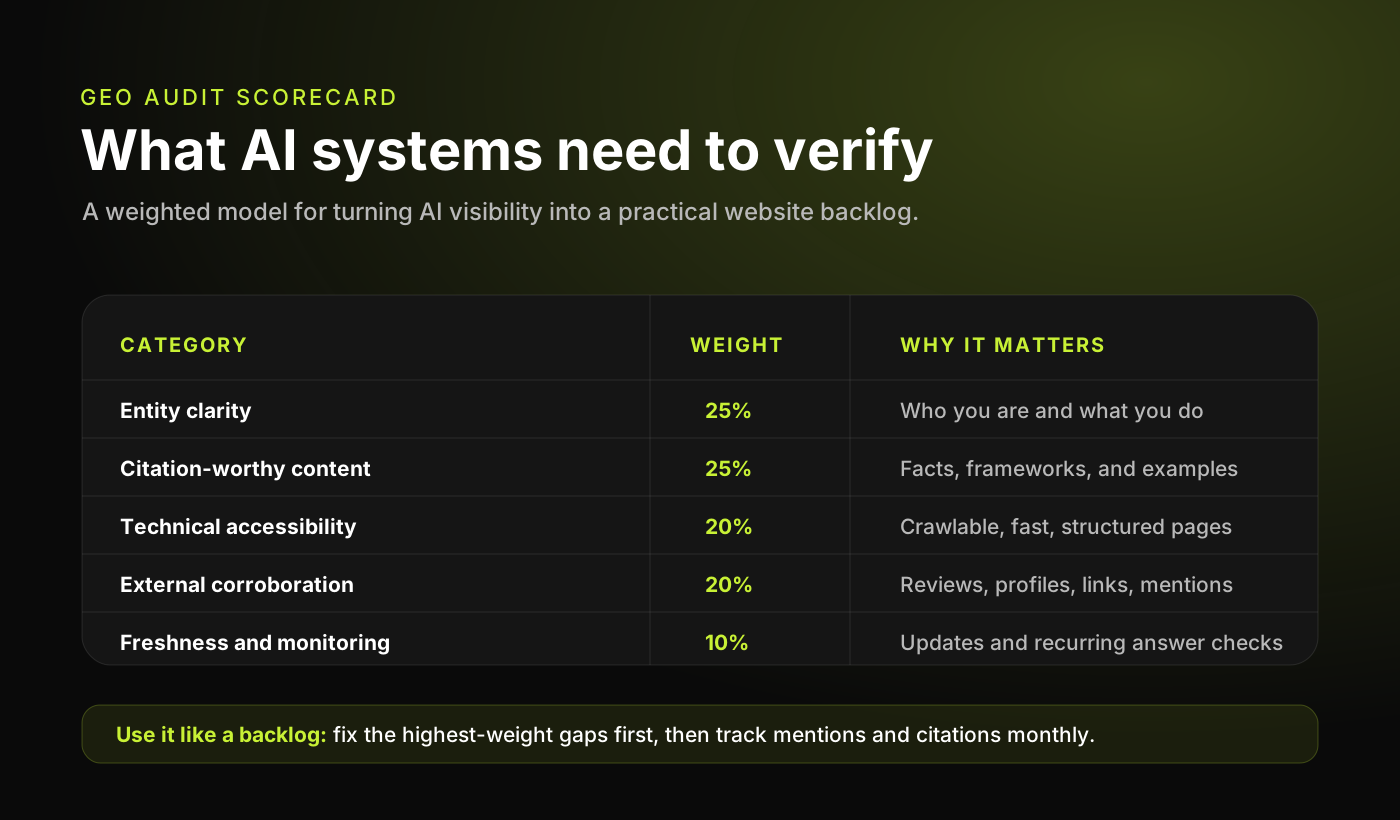
| Category | Weight | What strong looks like |
|---|---|---|
| Entity clarity | 25% | Your name, services, audience, location, founder/team, proof, and positioning are consistent across your website and public profiles. |
| Citation-worthy content | 25% | Your pages include specific definitions, original frameworks, comparisons, stats, examples, and concise answer blocks. |
| Technical accessibility | 20% | Important content is server-rendered, fast, crawlable, internally linked, and supported by schema where appropriate. |
| External corroboration | 20% | Reviews, directories, LinkedIn, Google Business Profile, client mentions, and trusted third-party pages reinforce the same story. |
| Freshness and monitoring | 10% | Important pages are maintained, dated, updated, and measured through recurring AI visibility checks. |
Step 1: Make the Entity Unmistakable
An entity is a company, person, product, place, or concept that search systems can identify. For your business, entity clarity means every important source says the same thing.
Your homepage, About page, Google Business Profile, LinkedIn company page, schema, and service pages should agree on:
- Company name
- Category
- Location or service area
- Services
- Target customers
- Founder or team expertise
- Proof points
- Contact details
If one profile calls you a marketing agency, another calls you an IT consultant, and your homepage says "digital solutions," AI systems have to infer what you are. That weakens confidence.
Entity clarity template
Use this sentence internally before rewriting public copy:
[Company] helps [audience] solve [problem] with [services], differentiated by [proof or approach].
Example:
Conspired Minds helps small businesses and founder-led teams build privacy-first websites, AI workflows, and search visibility systems, differentiated by senior technical execution, clear ownership, and practical security judgment.
That is the kind of statement machines and humans can understand.
Step 2: Write Extractable Answer Blocks
AI systems cite content at the paragraph or passage level. A 3,000-word article is useful only if individual sections can stand on their own.
A strong answer block has four traits:
- It answers one question directly.
- It uses specific nouns, not vague language.
- It includes enough context to be understood out of sequence.
- It avoids unsupported hype.
Weak:
We help businesses improve search visibility with modern strategies.
Strong:
A GEO audit reviews how a business appears in Google AI Overviews, ChatGPT, Perplexity, Claude, and Copilot. It checks citation frequency, answer accuracy, competitor mentions, entity clarity, schema, content structure, crawlability, and third-party proof.
The second version is more useful, more quotable, and easier to cite.
Step 3: Build Pages Around Buyer Questions
Do not start with keywords only. Start with the questions buyers ask before they hire, compare, or buy.
Examples:
- What is GEO?
- Is GEO replacing SEO?
- How do I know if AI tools mention my business?
- Why does ChatGPT recommend my competitors?
- What schema matters for AI search?
- How do I track AI visibility?
- What content gets cited in AI answers?
Then build each page so the answer is obvious. Use H2s and H3s that reflect real questions. Add tables where comparison helps. Add checklists where action helps. Add examples where abstraction gets fuzzy.
Step 4: Add Proof Where the Claim Happens
AI answer engines, like buyers, need reasons to trust you. Do not hide all proof on a separate testimonial page.
Put proof close to the claim:
- If you say you improve website performance, show Lighthouse targets or before/after metrics.
- If you say you understand local business, show reviews or local client examples.
- If you say you build privacy-first systems, show the specific stack choices.
- If you say you do GEO, show your audit process and measurement model.
Proof does not have to be loud. It has to be specific.
Step 5: Use Schema as Labels, Not Makeup
Structured data helps machines interpret what already exists on the page. It should not be used to pretend a page contains information it does not contain.
Priority schema types for GEO:
- Organization
- LocalBusiness
- Service
- Article or BlogPosting
- FAQPage
- BreadcrumbList
- Review, only when compliant and visible on the page
Schema is not a magic ranking button. It is labeling. The content still has to be worth recommending.
Step 6: Track AI Visibility Monthly
You cannot manage GEO if you only look at Google Analytics. AI visibility often creates zero-click awareness or direct traffic that analytics cannot attribute cleanly.
Use a recurring query set and track the results manually or with tools.
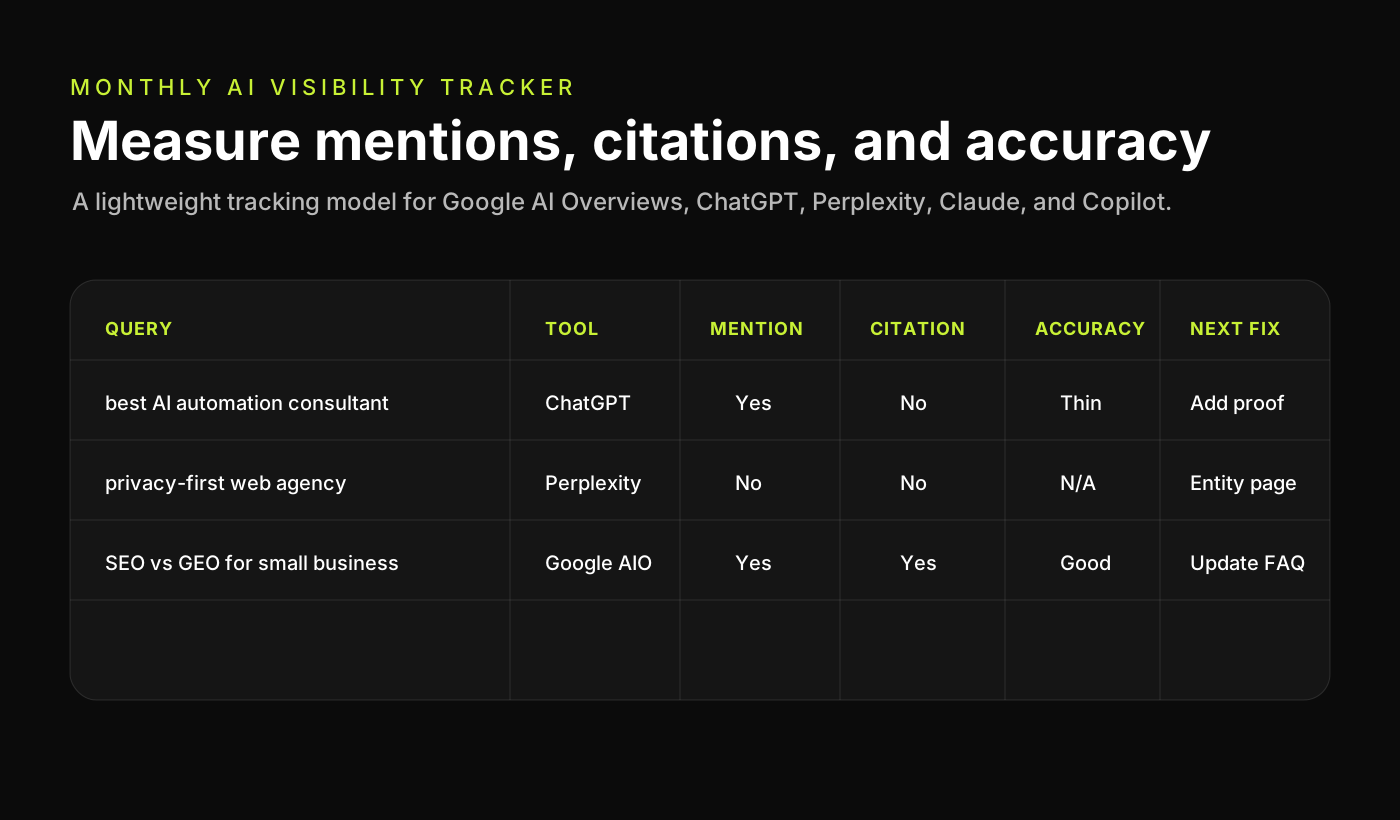
| Query type | Example | What to record |
|---|---|---|
| Brand | What does Conspired Minds do? | Accuracy, outdated claims, missing services. |
| Category | Best privacy-first web agency for small business. | Whether you appear, who appears instead, source citations. |
| Problem | How do I automate client intake securely? | Which frameworks, brands, and sources are cited. |
| Comparison | Astro vs WordPress for a business website. | Whether your content is cited for decision support. |
| Local | Brooklyn AI automation consultant for small business. | Local profile strength and competitor visibility. |
Track these fields:
- Tool tested
- Query
- Was the brand mentioned?
- Was the site cited?
- Was the answer accurate?
- Which competitors appeared?
- Which sources were cited?
- What page should be improved next?
Platform-Specific Notes
Google AI Overviews
Google AI Overviews are strongly connected to traditional search quality. Technical SEO, rankings, schema, local signals, and trusted source alignment still matter. Pages that are already clear and authoritative have an advantage.
ChatGPT Search
ChatGPT Search rewards clear, current, well-structured pages that answer the question directly. Brand/entity consistency matters because users ask conversational questions rather than short keywords.
Perplexity
Perplexity is citation-forward. It exposes sources clearly, which makes it useful for auditing. If Perplexity never cites your pages, your content may not be specific or source-worthy enough.
Claude and Copilot
Claude and Copilot are useful for checking whether your content is understandable and extractable. Ask them to summarize your company, compare your service page against a competitor, or identify missing proof.
A 90-Day GEO Implementation Plan
| Window | Priority | Output |
|---|---|---|
| Days 1-15 | Entity and technical foundation | Clean homepage positioning, Organization schema, crawlability check, service page clarity, Google Business Profile alignment. |
| Days 16-45 | Citation assets | Buyer-question articles, comparison pages, FAQ sections, proof blocks, original diagrams, service-specific answer blocks. |
| Days 46-75 | External corroboration | Reviews, directory cleanup, LinkedIn alignment, partner/client mentions, case studies, expert bios, relevant community proof. |
| Days 76-90 | Measurement and iteration | Monthly query tracker, competitor citation review, answer accuracy fixes, content refresh list, next-quarter backlog. |
GEO Content Checklist
- ☐ The page answers one primary buyer question clearly
- ☐ The first 150 words define the topic without fluff
- ☐ H2s and H3s reflect real questions and decisions
- ☐ Tables clarify comparisons or frameworks
- ☐ Checklists turn advice into action
- ☐ Images or diagrams explain something specific
- ☐ Claims are specific and supportable
- ☐ External links point to useful references where appropriate
- ☐ Internal links connect to relevant service pages
- ☐ Schema matches visible page content
- ☐ The page includes a clear next step
- ☐ The article has a recent published or updated date
Common Mistakes
Mistake 1: Publishing generic AI content
Generic AI content is easy to produce and easy to ignore. If a paragraph could appear on 500 competitor sites, it is not a citation asset.
Mistake 2: Confusing length with authority
Long content is not automatically authoritative. A short, specific answer block can be more valuable than a long section that never says anything concrete.
Mistake 3: Ignoring external corroboration
Your website is one source. AI systems compare signals across the web. Google Business Profile, reviews, LinkedIn, directories, press, YouTube, Reddit, and niche community mentions can all shape how your brand is represented.
Mistake 4: Measuring only traffic
GEO can influence buyers before they click. Track mentions, citations, answer accuracy, and competitor presence separately from website sessions.
Related Resources
- Generative Engine Optimization services
- SEO services
- SEO vs GEO: What Businesses Need to Know
- Contact Conspired Minds for a GEO audit
Useful References
- Google Search Central: structured data documentation
- Google Search Central: creating helpful, reliable, people-first content
- OpenAI: ChatGPT search overview
- Perplexity: publisher program and citations
- Semrush: Generative Engine Optimization guide
- Generative Engines research paper
FAQ
Is GEO replacing SEO?
No. GEO extends SEO. Traditional rankings, technical SEO, internal linking, page speed, local optimization, and authority still matter. GEO adds AI answer visibility, entity clarity, citation quality, and answer accuracy.
What is the fastest GEO improvement?
Rewrite the homepage and top service pages so they clearly state who you are, who you serve, what you do, and why you are credible. Then add FAQ sections and schema that match visible content.
How long does GEO take?
Structural improvements can be made in days. Brand/entity trust and citation frequency usually improve over months as content, reviews, links, and third-party mentions accumulate.
Can small businesses win in AI answers?
Yes. Small businesses can win by being more specific than larger competitors. Narrow expertise, local relevance, original frameworks, and clear proof can outperform generic agency content.
Do AI tools care about schema?
Schema helps search systems interpret content, but it is not enough by itself. Use schema to label strong visible content, not to compensate for thin pages.
What should I track every month?
Track brand mentions, citations, answer accuracy, competitor mentions, cited sources, and which page needs improvement next. Run the same query set each month so changes are visible.
Strategic Advice
The businesses that win in AI search will not be the ones with the most generic content. They will be the clearest, most useful, easiest to verify, and easiest to cite.
GEO is not a trick. It is disciplined clarity: say what you do, prove it, structure it, keep it current, and make it easy for both people and machines to understand.